The First Amendment Explained: What "Freedom of Speech" Actually Protects (And What It Doesn't)
Dale Porter · September 14, 2026 · 4 min read
Every few days, someone on social media announces they're being silenced and that their First Amendment rights are being violated — because a private company removed their post, a boss fired them for something they said, or a stranger told them their opinion was unwelcome.
Every few days, they're wrong.
That's not a partisan point. It's a constitutional one. And once you understand it, you'll never read the news the same way again.
The One Sentence That Changes Everything
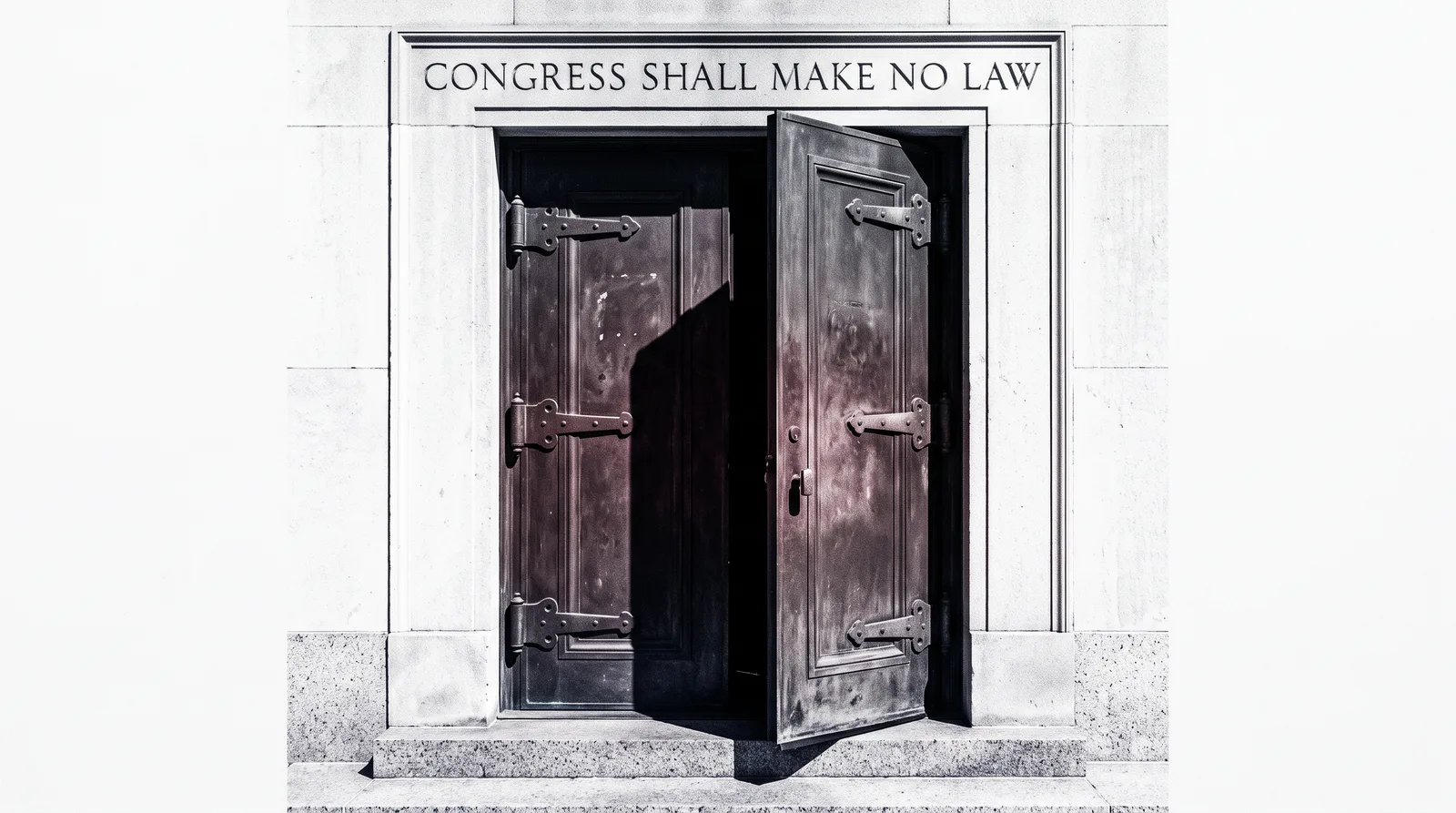
The First Amendment reads, in part: "Congress shall make no law… abridging the freedom of speech, or of the press."
Read those first two words again: Congress shall.
Later jurisprudence extended this restraint to all levels of government through the Fourteenth Amendment — but the core principle holds: the First Amendment is a restriction on government power, not a universal shield against consequences. It tells the government what it cannot do to you. It says nothing about what your employer, your landlord, your social media platform, or your neighbor can do.
This is the single most misunderstood fact in everyday constitutional conversation. Get it right, and you're already ahead of most people.
What the First Amendment Actually Protects
When the government is involved, the First Amendment's protections are genuinely broad. Courts have extended "speech" well beyond spoken words to include:
- Symbolic speech — burning a flag (Texas v. Johnson, 1989), wearing an armband to protest a war (Tinker v. Des Moines, 1969)
- Political speech — the most heavily protected category of all
- Unpopular and offensive speech — the Supreme Court has repeatedly held that the government cannot ban speech simply because it's hateful or disturbing
In Matal v. Tam (2017), the Court unanimously struck down a law that allowed the government to refuse trademarks for "disparaging" names. The government cannot pick which ideas are acceptable and suppress the rest. That's the rule.
Where the Boundaries Are
Even against the government, First Amendment protection is not absolute. Courts have carved out specific categories of speech that receive little or no protection:
True threats. Statements that communicate a genuine intent to commit violence against a specific person or group. (Virginia v. Black, 2003)
Incitement. Speech directed at producing imminent lawless action and likely to produce it. The bar is high — the Court set it in Brandenburg v. Ohio (1969), overturning a conviction because abstract advocacy of illegal ideas is still protected.
Defamation. False statements of fact that damage someone's reputation. But public figures face an even higher bar — they must prove actual malice under New York Times Co. v. Sullivan (1964).
Obscenity. Defined by a three-part test from Miller v. California (1973) — and courts apply it narrowly. Most edgy or offensive material doesn't meet the legal standard.
"Fighting words." Face-to-face provocations likely to cause an immediate breach of the peace (Chaplinsky v. New Hampshire, 1942) — though modern courts apply this category very sparingly.
Notice what's not on that list: speech you merely find offensive, speech that makes your workplace uncomfortable, or speech that gets you ratio'd online.
The Private Actor Rule in Plain English
Here's the practical rule to carry with you:
If a government actor — a police officer, a public school principal, a city council — punishes you for your speech, the First Amendment may protect you.
If a private actor — a corporation, a university that's a private institution, a social media company — does the same thing, the First Amendment is simply not in play.
Twitter (now X), Facebook, and YouTube are private companies. They can remove content, ban accounts, and set community standards entirely at their own discretion — and no First Amendment claim applies. You may disagree with their policies. You may think they're unfair. That's a legitimate debate. But it's a policy debate, not a constitutional one.
Public universities are a different story, because they are government actors. A state school disciplining a student for political speech faces genuine First Amendment scrutiny. A private college does not.
Why This Matters Beyond Trivia
Understanding this distinction isn't just useful for winning arguments online. It's the foundation of constitutional literacy. The Bill of Rights is fundamentally a list of things the government cannot do to you — not a general ethics code for how everyone must treat each other.
When people misapply the First Amendment to private disputes, two things happen: they lose the argument, and they weaken public understanding of what the Amendment actually does. And what it actually does — restrain government censorship and protect open political discourse — is extraordinary. It's worth knowing precisely.
Keep Going
If this clicked for you, you're ready to go deeper. In my Rights & the Law course, we walk through all ten amendments of the Bill of Rights — not in the abstract, but through the landmark cases, real-world encounters, and settled doctrine that show you exactly how these protections work in practice. Because knowing you have rights is one thing. Knowing how they work is what actually protects you.