
What Does 'Limited Government' Actually Mean? A Plain-English Breakdown
Dale Porter · September 14, 2026 · 5 min read
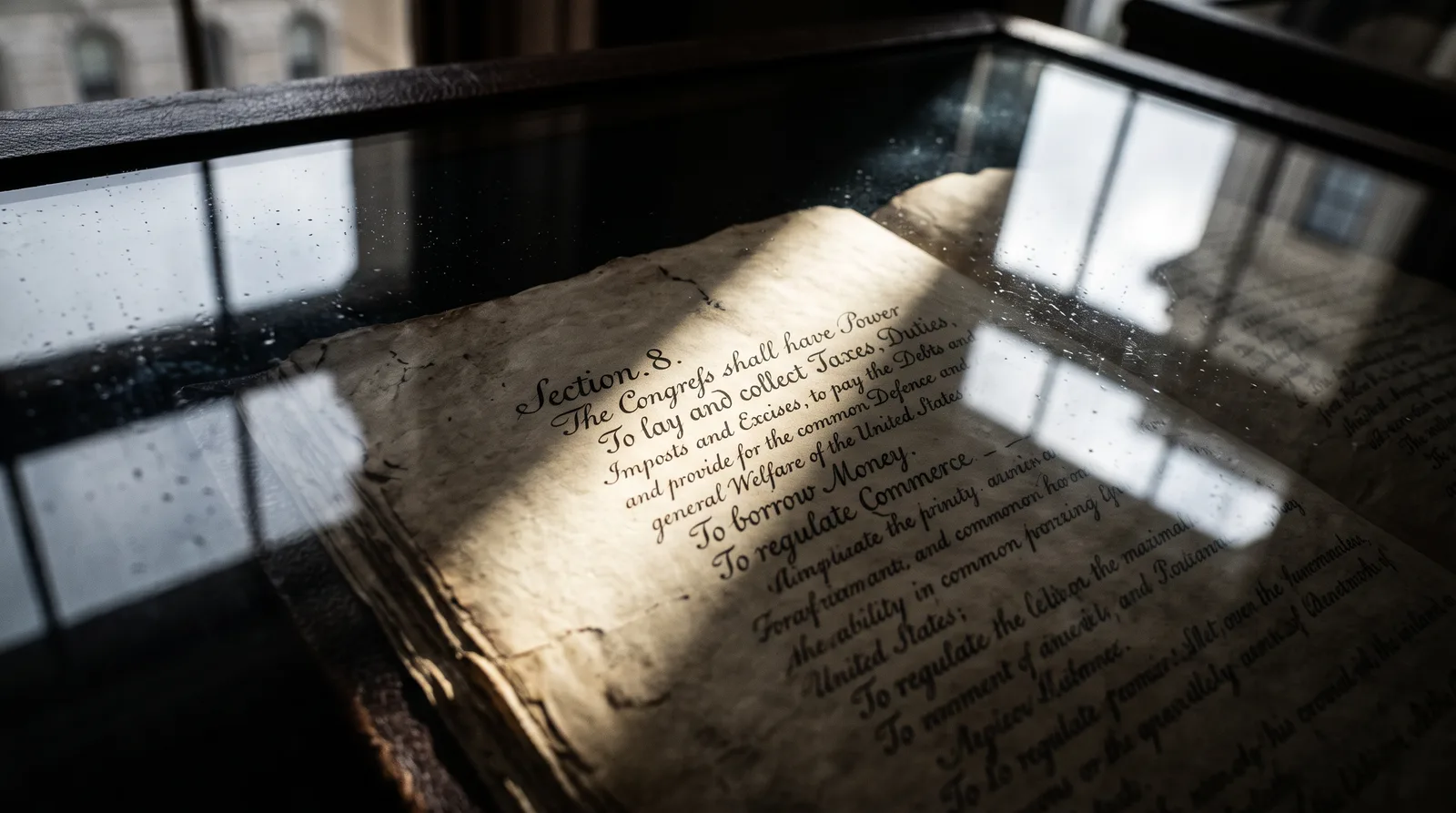
"Limited government" gets thrown around in political speeches so often that it has almost stopped meaning anything. Conservatives invoke it. Libertarians tattoo it on their worldview. Critics dismiss it as code for cutting programs they like. But here's what almost nobody tells you: limited government is not a philosophy or a slogan — it is a specific legal structure, designed with engineering precision, written into the text of the Constitution itself.
Once you understand the actual mechanism, you can evaluate any political argument — left, right, or center — on its constitutional merits rather than its emotional temperature. That's the goal of this post.
The Core Idea: A Government of Enumerated Powers
Start with Article I, Section 8 of the Constitution. It lists the powers Congress is authorized to exercise — coin money, establish post offices, declare war, regulate commerce among the states, and about a dozen others. This list is not decorative. It is definitional.
The Framers were operating from a principle that is the exact opposite of how most people assume government works. The default assumption today tends to be: government can do anything unless a law prohibits it. The Framers flipped that completely. Their design says: government may only do what the Constitution specifically authorizes. Everything else is off the table.
This is what "enumerated powers" means. The word enumerate simply means to list. The federal government's powers are listed. Unlisted powers don't exist at the federal level. That's the whole game.
The Tenth Amendment Is the Lock on the Door
If Article I, Section 8 is the list of authorized powers, the Tenth Amendment is the enforcement clause. It reads, in full:
"The powers not delegated to the United States by the Constitution, nor prohibited by it to the States, are reserved to the States respectively, or to the people."
Read that slowly. It says that anything not handed to the federal government belongs — by default — either to state governments or to individual citizens. This wasn't an afterthought. The Tenth Amendment was added precisely because the Framers feared that future generations would forget the enumerated-powers principle and start treating federal authority as unlimited.
They were not wrong to worry.
Why the Framers Saw Government Size as a Liberty Issue
This is the part that modern conversation almost always skips, and it's the most important part.
The Framers did not think government was evil. Several of them — Hamilton especially — believed a vigorous central government was essential. But virtually all of them agreed on one thing: concentrated power, wherever it collects, becomes a threat to individual liberty. History had shown them this over and over, from Roman emperors to the British Crown's treatment of the colonies.
Their solution was to divide power in three ways simultaneously:
- Vertically — between the federal government and the states (federalism)
- Horizontally — among the three branches of the federal government (separation of powers)
- Individually — by reserving certain rights to the people that no government could touch (the Bill of Rights)
Limited government, in this framework, is not about doing less for its own sake. It is about preventing any single power center from accumulating enough authority to override the rights of individuals. Size matters because a government large enough to give you everything is large enough to take everything away.
A Practical Test You Can Apply Right Now
Here is a simple constitutional test you can run on any proposed federal action:
- Where in Article I, Section 8 is this power listed?
- If it isn't listed, does another constitutional provision — like the Fourteenth Amendment — grant this authority?
- If neither, should this be a state matter, a local matter, or no government matter at all?
This doesn't automatically tell you whether a policy is good. A state government could adopt a terrible policy that is still perfectly constitutional. But it tells you who is supposed to be making the decision — and that matters enormously, because local and state governments are far more accountable to the people they govern than a distant federal bureaucracy.
What "Erosion" Actually Looks Like
The Commerce Clause — the part of Article I, Section 8 that lets Congress regulate commerce "among the several States" — has been stretched by Supreme Court interpretation over the past century to cover an enormous range of activity that the Framers almost certainly would not have recognized. This isn't a conspiracy; it's the result of real political pressures, real crises, and real court decisions, each building on the last.
Understanding limited government means understanding how that expansion happened — through precedent, legislation, and constitutional amendments — so you can evaluate it honestly rather than simply cheering or booing based on which party is in power.
This Is the Foundation
Everything else in constitutional civic education — the Bill of Rights, federalism, separation of powers, the amendment process — rests on this foundation. If you don't understand enumerated powers and the Tenth Amendment, the rest of the Constitution is much harder to read clearly.
In my courses, especially Plain Text Constitution and Republic vs. Socialism vs. Communism, we go through these mechanisms clause by clause, case by case, so that the document stops being intimidating and starts being readable. Because the supreme law of the land was written to be understood by ordinary citizens — and it still can be.
Start with the list. Know the lock on the door. The rest follows.